
Four Basic Rights
Eleanor Roosevelt’s Social Thought
13 May 1944
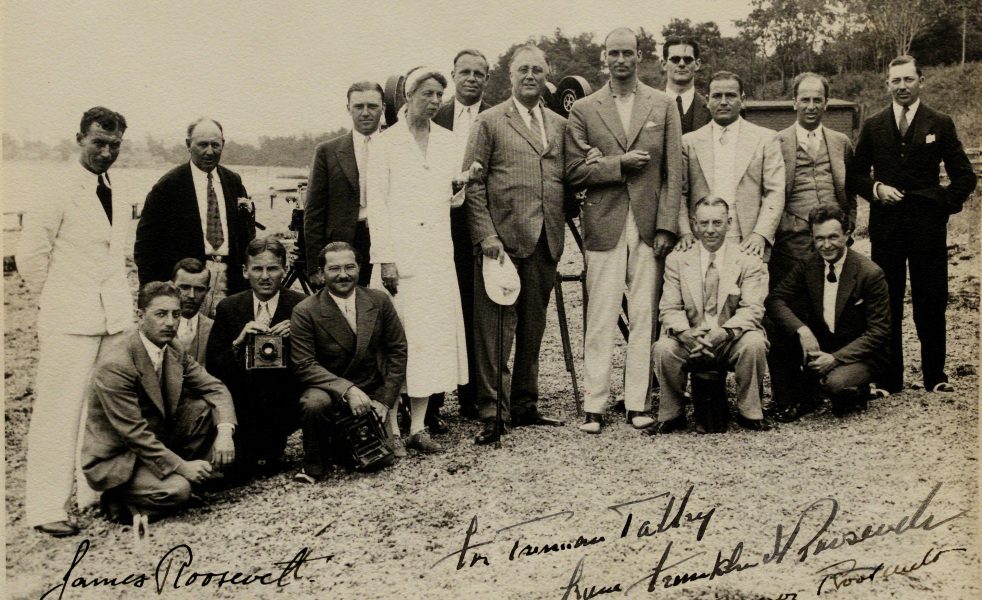
The photograph below shows Eleanor Roosevelt standing by her husband’s side, as several other men pose for the camera. Although she is surrounded by men, Eleanor Roosevelt does not appear to be at all fazed by her environment. Quite the contrary; she appears to be comfortable, at ease. President Truman called Eleanor Roosevelt the ‘First Lady of the World’, in tribute to her human rights achievements. Indeed, terrified that she must conform to the established duties of ‘First Lady’, Eleanor set out to redefine the role, perhaps seeing it as a golden opportunity to pursue her political ambitions. In a society where few married women had established careers, Eleanor’s involvement in press conferences and national party conventions attracted criticism.
Despite her fervent support for the implementation of equal civil rights for all, Eleanor Roosevelt was eager to establish that she by no means ‘advocated social equality between colored and white people’. She asserted that this was a strictly personal issue. Instead, and as this letter shows, she identified four ‘basic rights’, which she believed every single member of a democracy must be entitled to. These included right to equal education, the right to work for equal pay according to ability, the right to justice under the law, and the right to participate in use of the ballot.
Undeterred by conformist disapproval, Eleanor set out to transform the lives of the African-American population, who were suffering during the segregation era. Critical of the unfair nature of the New Deal programs, Eleanor voiced her opinions to a silent White House, asserting that benefits should apply equally to Americans of every race. Eleanor further pursued equal rights for African Americans when in 1934 she lobbied for the Costigan-Wagner Bill to make lynching a federal crime. Unsurprisingly, some of Eleanor’s actions were met with opposition, particularly in the south, where racial segregation was prevalent. However, Eleanor was not discouraged, and instead formed strong relationships with African-American women, such as educator Mary McLeod Bethune.
Roosevelt was a significant influence on the establishment of human rights for all. Indeed, Eleanor Roosevelt’s ‘Four Basic Rights’ was the inspiration behind the United Nations Declaration of Human Rights, General Assembly Resolution 217A. It is clear to identify Eleanor Roosevelt’s influence on her husband’s ‘Four Freedoms’ which incorporate themselves into the preamble to the Universal Declaration of Human Rights:
Whereas disregard and contempt for human rights have resulted in barbarous acts which have outraged the conscience of mankind, and the advent of a world in which human beings shall enjoy freedom of speech and belief and freedom from fear and want has been proclaimed the highest aspiration of the common people.
View more documents relating to the First Lady
View more documents relating to Women's History
View more documents by women authors
View more documents relating to the President
View more documents relating to African American history