
Always include a date stamp on every essay and video interview.
Use the sidebar for essays with internal section titles to aid navigation.
Formatting of author citation: Academic name, Title/Job, University/Institution
Endnotes rather than References.
Bibliography (every source the author has used for the essay) and Further Reading (recommendations by the author) sections can also be included at the bottom if the author desires.
Making an Impact: Women in the NBC and RCA (Heading 1)
Kristin Skoog, Principal Academic in Media History, Bournemouth University (Paragraph text and bold)
Published in 2025. (Paragraph text in italics and bold)
At the annual shareholder meeting of Radio Corporation of America (RCA) in May 1957, David Sarnoff (1891-1971) - the American radio pioneer, founder of the National Broadcasting Company (NBC) in 1926, and President of the RCA - was asked if women held any top management positions at RCA and its subsidiaries. Sarnoff answered by giving an outline of the situation: ‘At RCA women occupy important positions in training, personnel, accounting, advertising, public relations, radio, and television program production, costume design, as well as research and engineering.’ Sarnoff further provided specific numbers, for instance, one woman was in an executive position at the Harrison, New Jersey plant, and RCA currently employed 29 women as engineers in its laboratories, and NBC had over 1500 women in the organization with over 200 women holding ‘key positions of substantial responsibility.’ Finally, he noted that 43% of RCA shareholders were women (this figure was slightly higher than the share of men).[1]
.....
Always include a date stamp on every essay and video interview.
Use the sidebar for essays with internal section titles to aid navigation.
Formatting of author citation: Academic name, Title/Job, University/Institution
Endnotes rather than References.
Bibliography (every source the author has used for the essay) and Further Reading (recommendations by the author) sections can also be included at the bottom if the author desires.
Making an Impact: Women in the NBC and RCA (Heading 1)
Kristin Skoog, Principal Academic in Media History, Bournemouth University (Paragraph text and bold)
Published in 2025. (Paragraph text in italics and bold)
At the annual shareholder meeting of Radio Corporation of America (RCA) in May 1957, David Sarnoff (1891-1971) - the American radio pioneer, founder of the National Broadcasting Company (NBC) in 1926, and President of the RCA - was asked if women held any top management positions at RCA and its subsidiaries. Sarnoff answered by giving an outline of the situation: ‘At RCA women occupy important positions in training, personnel, accounting, advertising, public relations, radio, and television program production, costume design, as well as research and engineering.’ Sarnoff further provided specific numbers, for instance, one woman was in an executive position at the Harrison, New Jersey plant, and RCA currently employed 29 women as engineers in its laboratories, and NBC had over 1500 women in the organization with over 200 women holding ‘key positions of substantial responsibility.’ Finally, he noted that 43% of RCA shareholders were women (this figure was slightly higher than the share of men).[1]
.....
Women in executive, managerial, and advisory positions
In the 1920s and 1930s around the world ...
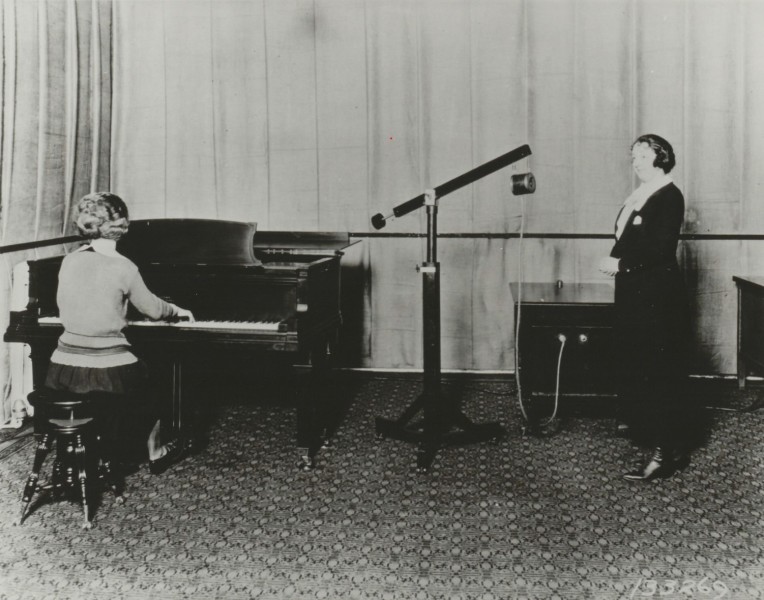
Two women performing at KDKA studio, Pittsburgh, c.1921
Content Compilation © 2023, by the Hagley Museum & Library. All rights reserved
Women in executive, managerial, and advisory positions
In the 1920s and 1930s around the world ...
Two women performing at KDKA studio, Pittsburgh, c.1921
Content Compilation © 2023, by the Hagley Museum & Library. All rights reserved
Women in technical, manufacturing, and engineering roles
Women did not only play a key role as broadcasting executives ...
Women in technical, manufacturing, and engineering roles
Women did not only play a key role as broadcasting executives ...
Women calling for change, recognition, and respect
In the period following the Second World War ...
Women calling for change, recognition, and respect
In the period following the Second World War ...
Conclusion
This essay set out to explore the role of women ...
Conclusion
This essay set out to explore the role of women ...
Endnotes
[1] Proceedings of Annual Meeting of Stockholders, 7 May 1957, 358.
[2] See for example Michele Hilmes, Radio Voices: American Broadcasting, 1922-1952 (Minnesota: University of Minnesota Press, 1997), 130-182; Christine Ehrick, Radio and the Gendered Soundscape: Women and Broadcasting in Argentina and Uruguay, 1930-1950 (New York: Cambridge University Press, 2015); Kate Murphy, Behind the Wireless: A History of Early Women at the BBC (London: Palgrave Macmillan, 2016); Justine Lloyd, Gender and Media in the Broadcast Age: Women’s Radio Programming at the BBC, CBC, and ABC (New York: Bloomsbury Academic, 2020).
Endnotes
[1] Proceedings of Annual Meeting of Stockholders, 7 May 1957, 358.
[2] See for example Michele Hilmes, Radio Voices: American Broadcasting, 1922-1952 (Minnesota: University of Minnesota Press, 1997), 130-182; Christine Ehrick, Radio and the Gendered Soundscape: Women and Broadcasting in Argentina and Uruguay, 1930-1950 (New York: Cambridge University Press, 2015); Kate Murphy, Behind the Wireless: A History of Early Women at the BBC (London: Palgrave Macmillan, 2016); Justine Lloyd, Gender and Media in the Broadcast Age: Women’s Radio Programming at the BBC, CBC, and ABC (New York: Bloomsbury Academic, 2020).